The Weaving of the Andes: Why Alpaca is Much More Than Its Fiber
Looking up at the majestic peaks of South America, we encounter one of our planet's oldest, most unique, and resilient ecosystems: the high-Andean grasslands. Their history dates back to a period between three and five million years ago, born as a result of the uplift of the Andes mountain range and drastic climatic changes. In this extreme environment, life thrived through the co-evolution of plant and animal species
To this fragile equilibrium was added, some ten thousand years ago, the presence of humankind. Far from destroying their environment, ancestral communities shaped these ecosystems through traditional management that allows for continuous utilization without altering their vital ecological function in the slightest.
The Alpaca: A Masterpiece of Adaptation
South American camelids developed within this rigorous evolutionary scenario. Among them stands the alpaca, the primary domesticated species of this group and a true biological prodigy. Unlike livestock introduced centuries later, the anatomy and physiology of the alpaca reflect its extraordinary adaptation to high altitudes:
Soft Paw Pad: Instead of hard hooves that erode the earth, they possess plantaris pads that minimize impact on the delicate Andean soil.
Respectful Grazing: Their feeding method cuts vegetation without pulling it up by the roots, allowing grasses to regenerate rapidly.
Digestive Efficiency: They have an unmatched capacity to nourish themselves exclusively on high-Andean forages.
These unique characteristics make the alpaca a functional and harmonious component of the ecosystem, rather than an agent of degradation.
Ancestral Sustainability and the Ecosystem Product
The domestication of the alpaca occurred over five millennia ago, and its breeding continues under traditional extensive systems. Alpacas feed on natural pastures and drink pristine water from headwaters. It is a closed, clean, and deeply respectful system.
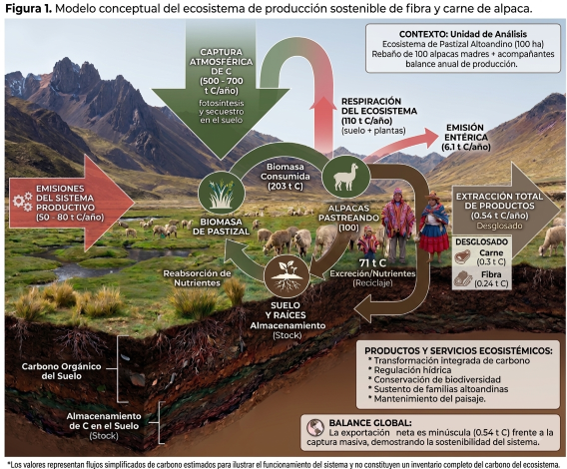
High-Andean grasslands are gigantic carbon sinks that capture carbon dioxide through photosynthesis. The alpaca is part of the grassland ecosystem and transforms part of this biomass into fiber, returning organic matter through its excreta and closing a perfect cycle.
Therefore, the fiber is a true "ecosystem product." Every kilogram carries the combined work of the soil, water, sun, and the millennial knowledge of its herders.
A Pending Debt
Unfortunately, today's global market ignores this invisible wealth. The stored carbon, landscape conservation, and valuable ecosystem services provided by alpaca-herding families remain poorly recognized and without fair economic reward.
Faced with this reality, the task is urgent: we need to implement certification systems that recognize the ecological value of the fleece. Promoting payments for ecosystem services and voluntary carbon markets will make fair compensation for producers possible. Recognizing the true value of alpaca fiber is honoring the majesty of the Andean ecosystem that makes it possible. Only thus will we achieve a truly ethical and sustainable industry.